Is AI Taking Away Web Developers' Jobs? The Reality in 2026

· 6 min read
The short answer is yes AI is taking over a significant portion of web developers' work—but not everyone's job, and not every task. Beginners and developers who earn money primarily by installing templates or building basic landing pages are feeling the greatest pressure.
Just a few years ago, we used to say, "Learn HTML, CSS, a little JavaScript, and WordPress, and you can start earning through freelancing." In 2026, that statement is no longer entirely true. Today, a client can write a prompt in an AI tool and build a functional website in just 30 minutes.
In this article, we'll look beyond emotions and examine the data to understand what's actually happening, whose jobs are at risk, who is managing to stay competitive, and what you should do next.
What the Data Says: The Door Is Closing for Beginners
The impact is most visible at the junior level. The bigger problem isn't just layoffs; companies are also hiring fewer junior developers in the first place. The following figures come from separate studies and analyses:
| What Was Measured | Change | Source |
|---|---|---|
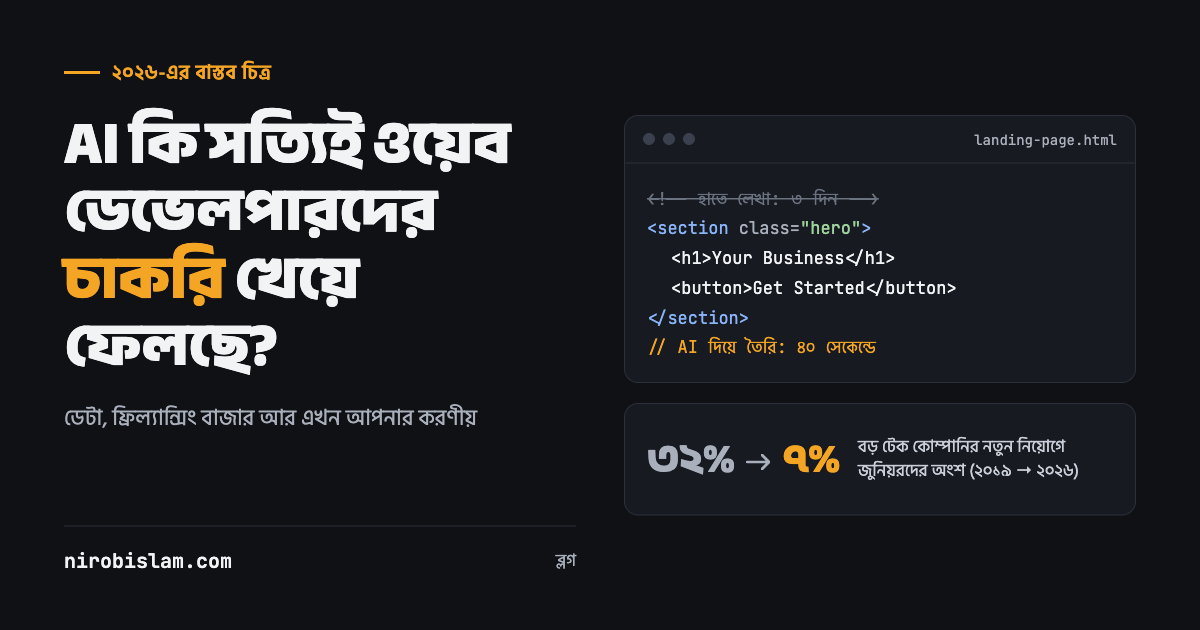
| Share of junior employees in new hires at major tech companies (2019–2026) | Approximately 32% to 7% | Managed Code |
| Employment among 22–25-year-olds in AI-exposed occupations | 16% relative decline | Stanford / ADP payroll research |
| Employment among 35–49-year-olds in the same occupations | 6–9% increase | Stanford / ADP payroll research |
| Junior employment at AI-adopting companies over six quarters | 9–10% decline | Harvard research involving 62 million workers |
| Job postings for web development, Android, iOS, and .NET roles since 2020 | Down 60% or more | Indeed Hiring Lab analysis |
| Job postings for machine learning engineers over the same period | Up 59% | Indeed Hiring Lab analysis |
| Developers regularly using AI tools | 84% | Stack Overflow 2025 Survey |
The picture is clear: experienced developers are holding their ground, and demand for their skills may even be increasing. But the lower rungs of the ladder that once helped beginners become experienced developers are beginning to disappear.
Another important point is that jobs aren't necessarily disappearing altogether; they're shifting. Traditional web development positions are declining, while AI- and machine-learning-related roles are growing.
Freelancing: The Real Shock for Bangladeshi Developers
A large proportion of web developers in Bangladesh don't work in traditional jobs. Instead, they earn through marketplaces such as Upwork and Fiverr. This is precisely where the impact has been particularly noticeable.
- A study published in the journal Management Science found that freelance job postings for software and web development declined by approximately 20.6% in the months following ChatGPT's launch, according to its reported summary.
- In 2026, a major freelance platform reportedly acknowledged that declining revenue was largely driven by simpler work categories, including basic copywriting, general graphic design, and entry-level programming, where clients are increasingly using AI instead of human freelancers (Calcalist).
- Another study found that having previously strong ratings or a good work history did not necessarily protect freelancers from this decline.
What does this mean in practice? A client who previously paid $50–$100 for a landing page, portfolio website, or small bug fix may now complete the task independently using AI. Meanwhile, the remaining projects attract several times more competition than before.
However, there's another side to the story. Demand is growing for more complex work, such as complete e-commerce systems, mobile apps, AI chatbots, and API integrations. These categories can also offer comparatively better rates.
Which Tasks Are Disappearing, and Which Are Surviving?
AI isn't replacing the entire profession at once. It's taking over specific tasks within the profession. Use the following comparison to assess where your skills stand:
| Tasks Under Greater Pressure | Tasks That Remain Valuable and Are Growing |
|---|---|
| Converting designs into HTML/CSS code | Understanding business problems and designing solutions |
| Basic landing pages and portfolio websites | Large-scale and scalable system architecture |
| WordPress websites built primarily from templates | Security, performance, and database optimization |
| Basic CRUD applications and boilerplate code | Integrating AI models and APIs into web applications |
| Small bug fixes and writing simple tests | Reviewing, correcting, and taking responsibility for AI-generated code |
| Writing documentation and explaining code | Communicating with clients and understanding requirements |
An Indian career analysis describes this shift as AI absorbing entry-level CRUD work while developers increasingly move toward system design and performance optimization (CorpReady). According to that analysis, specialists may see relatively stable pay, while generalists who know a little about everything face growing salary pressure.
The Other Side of the Story: AI Isn't Entirely to Blame
To understand the situation realistically, we must also acknowledge several counterarguments.
- Not every decline is caused by AI. According to Indeed's analysis, roughly half of the net decline in tech job postings had already occurred before ChatGPT was released. Higher interest rates and the post-pandemic correction following excessive hiring also played major roles.
- The impact varies by country. A similar study in Denmark found an almost negligible effect, suggesting that economic structures and policies matter considerably.
- AI-generated code isn't perfect. A Veracode study found that 45% of AI-generated code samples failed basic OWASP security tests. The more AI-generated code we use, the greater the need for people who can verify its safety and quality.
- Where will tomorrow's senior developers come from? If companies stop hiring juniors today, they could face a shortage of experienced developers in five to seven years. This is one reason some companies, including IBM, have reportedly moved in the opposite direction by increasing entry-level hiring threefold while changing the nature of the work.
Therefore, saying "web development is over" is just as misleading as claiming that "nothing has changed."
What Should You Do Now? Practical Advice
Sitting back in fear won't help. You can start taking the following steps this month:
Make AI your assistant, not your competitor. Use tools such as Cursor, Copilot, or Claude to work faster. Developers who use AI to become three times as productive are not necessarily the ones who will be replaced by AI.
Move from simply writing code to solving problems. Clients don't really want a website; they want more sales, more leads, or lower costs. Learn to communicate in terms of those business outcomes.
Develop deeper technical expertise. Database design, security, performance optimization, and cloud deployment are areas where AI still cannot be relied upon to handle everything independently.
Learn AI integration. Building chatbots, smart search systems, and automation tools using the OpenAI or Anthropic APIs is an increasingly relevant area of freelance development.
Become skilled at code reviews and testing. Identifying mistakes in AI-generated code is a valuable skill, and the ability to verify code quality is becoming increasingly important.
Move beyond low-cost gigs. Competing with AI on $5 projects is difficult. Choose a small but higher-value niche, such as Shopify store optimization, SaaS dashboards, or booking systems.
Build your personal brand. Use a blog, case studies, and GitHub projects to demonstrate the real problems you've solved for clients or through independent projects.
If you're just starting to learn, remember one additional thing: asking AI to write code and understanding that code are two different skills. Without hands-on knowledge of fundamentals such as JavaScript, HTTP, and databases, you'll never develop the ability to reliably identify AI's mistakes.
Final Thoughts
AI is affecting web developers' jobs. There's no denying that, especially when it comes to beginners and routine, entry-level work. But what's declining isn't necessarily web development itself; it's the traditional approach of getting paid simply to type code.
Opportunities may actually increase for developers who can use AI to deliver greater value. So the question isn't simply, "Will AI take my job?" The more important question is, "Will another developer who knows how to use AI take my place?"
What's your experience? Have you noticed any changes in your workload or income since AI became widely available? Share your thoughts in the comments.